Key takeaways
- Price is the most common complaint at UK private clinics. It comes up in 45% of negative reviews.
- Your specialty predicts what your patients complain about: hair transplant clinics get sales pressure, eye clinics get appointment problems, and fertility clinics get complaints about how the care team treated people.
- Your region matters less than your specialty, as far as we can measure it. The largest regional gap we can confirm is 3 points, and the specialty gaps run to 23. No specialty has enough reviews to split by region.
- Private hospital patients complain about appointments, reception and follow-through more than about money.
- Patients praise people and results in five-star reviews. In one- and two-star reviews they write about money, and about what happened when something went wrong.
Why I did this
I spend my days reading the Google reviews of private clinics. Patients read them before they call, and clinic owners rarely get to see what patients across their whole specialty say, rather than just their own.
Most clinic owners I talk to think their complaints are theirs alone: the deposit argument, the receptionist, the patient who felt sold to. Some of that is industry-wide, and you cannot tell which until you can see your whole specialty. It cuts the other way too: if every clinic in your specialty gets a complaint and yours does not, that is a claim you can make in plain words.
So we collected the reviews of every UK private specialist clinic and private hospital we could identify, and tagged each negative one by what it complains about.
The 21,618 reviews split three ways: 12,497 of clinics, 7,018 of private hospitals and 1,803 of named practitioners. They come from 2,863 businesses with at least one negative review with text, out of 12,158 in scope. Most of this article is about the clinics.
The benchmark tool lets you look up your own specialty or region.
Six specialty gaps, and what I think is behind them
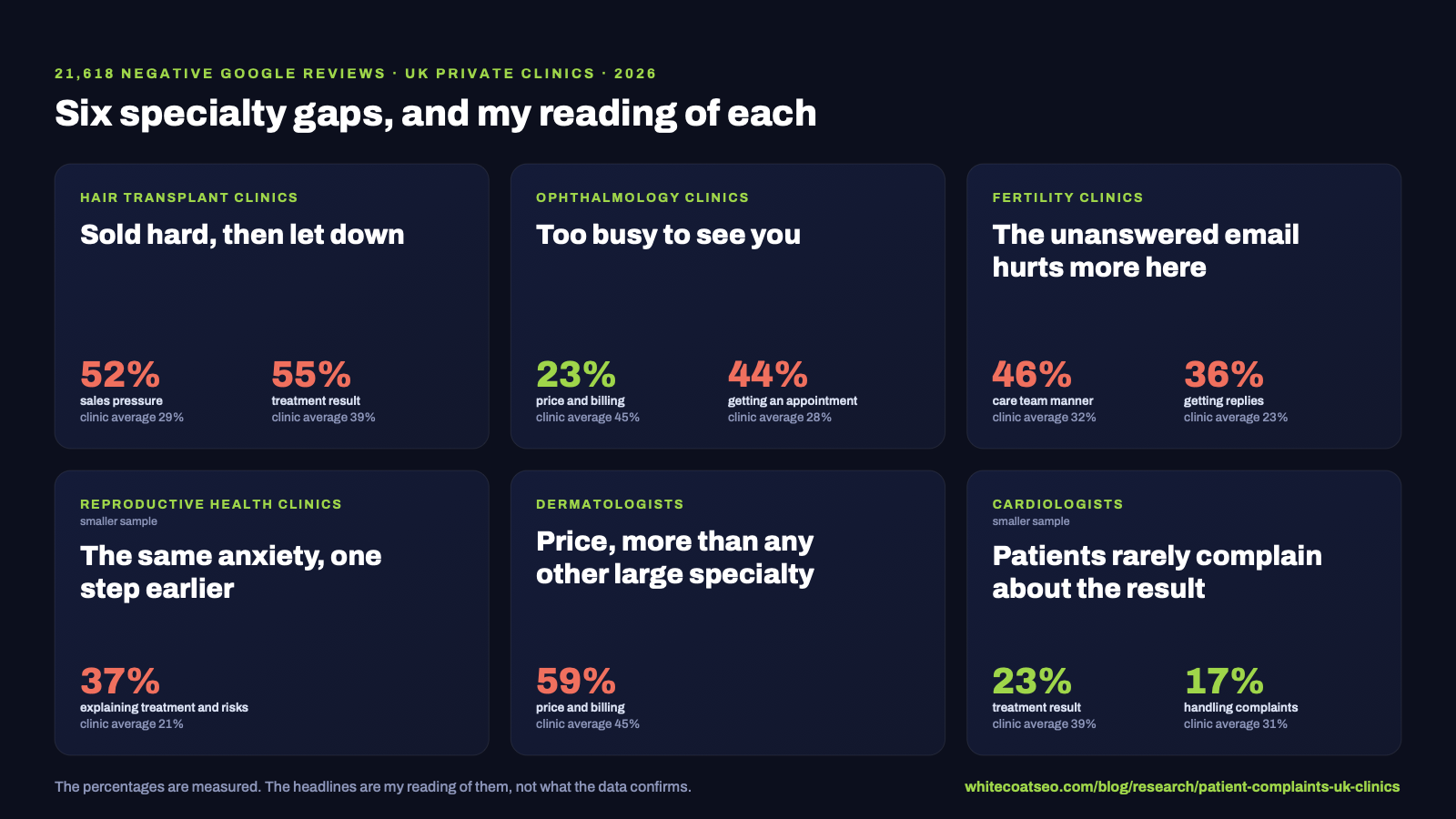
The percentages are measured. The readings are mine, and nothing in the data confirms them. Where we could put a reading to the reviews, I say what came back, including where it went against me.
Hair transplant clinics: sold hard, then let down. Sales pressure 52% (all clinics 29%), treatment result 55% (39%). My reading: a crowded market that sells hard, and a bad or OK result smarts after big promises made in the sales process. The two complaints travel together here more than anywhere else: 64% of reviews raising sales pressure also raise the result, against 50% elsewhere, and "overpromised or misleading claims" is 32% against 12%. On a blind re-read of 300 of these reviews, 41% say the writer was promised or sold a result and that what they got fell short, against 29% of a matched sample from other clinics.
Eye clinics: too busy to see you. Price 23% (45%), getting an appointment 44% (28%). My reading: they compete on price and fill the diary to make it pay. The busy half shows in the reviews: "kept waiting past appointment time" is 20% against 10%, and on a blind re-read of 300 of their reviews, 31% describe a clinic that is busy, overbooked or running late, against 18% elsewhere. The cheap half does not show at all. A low price or a deal is mentioned in 5% of their reviews, the same as everywhere else, and price is praised in 2 of 120 of their five-star reviews.
Fertility clinics: the unanswered email hurts more here. Care team manner 46% (32%), getting replies 36% (23%); fertility physicians run higher still, at 48% and 41%. My tentative reading: the treatment is slow, emotional and potentially life-changing, so an ignored email or an insensitive member of staff feels worse than it would at a skin clinic. The manner complaint reads as cold rather than rude: 46% of their manner complaints are coded cold or neglectful and not rude, against 25% elsewhere. And on a blind re-read of 400 reviews from the fertility and reproductive health groups, 43% describe the writer's own anxiety, distress or what was riding on the outcome, against 23% of a matched sample from other clinics.
Reproductive health clinics: the same anxiety, one step earlier. Explaining treatment and risks 37% (21%), from a smaller sample of 414 reviews. My reading: an anxious patient needs the explanation and notices when it is missing. The same cold-not-rude pattern, 46% against 27%, and these clinics are in the re-read figure above.
Dermatologists: the price complaint, more than any other large specialty. Price 59% (45%), carried by "overpriced for what you get" at 35% against 26%. My reading: the tilt towards aesthetic work in private dermatology.
Cardiologists: patients rarely complain about the result. Treatment result 23% (39%), handling complaints 17% (31%), from 163 reviews, so a lead rather than a finding. I have no reading for this one. What their patients raise instead: "poor-quality scans and tests" 14% against 4%, and "wrong or missed diagnosis" 14% against 5%.
What patients complain about
A one- or two-star review raises four topics on average. These are the twelve most common, as a share of all negative clinic reviews.
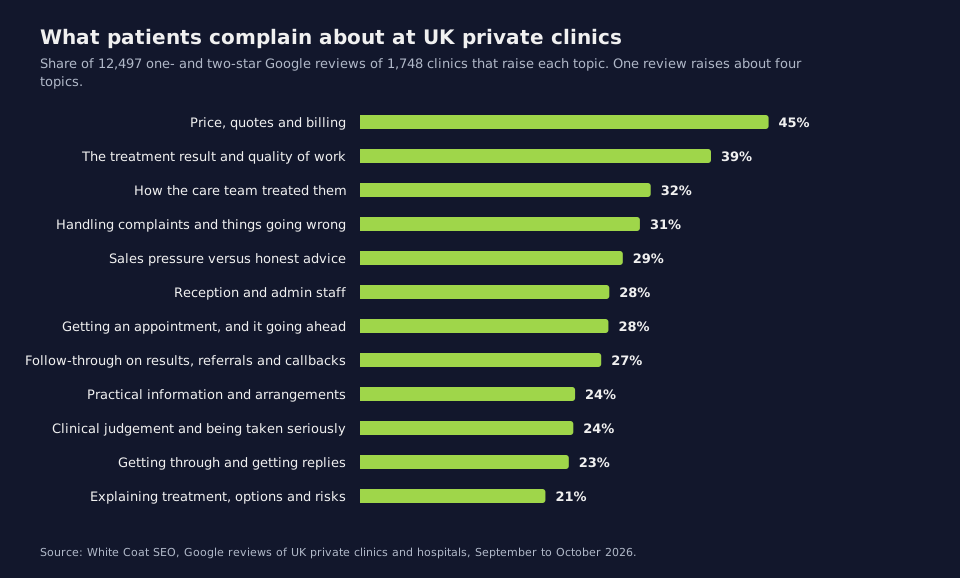
Figure 1. Share of 12,497 negative clinic reviews raising each topic. A review raises about four.
Price is first by some distance. The single most common named reason across all clinic reviews is "overpriced for what you get", in 26% of them. The rest of the price complaints are about a charge the patient did not expect or could not get back: charged for undelivered or repeat care (10%), refunds and deposits withheld (10%), fees not disclosed upfront (9%), and charged more than quoted (5%). A review can name more than one.
In the patients' words:
"They are not clear about their prices."
"repeatedly issued with incorrect invoices"
"my deposit was immediately taken"
"they have refused to return my payment"
The treatment result comes second. Then come three topics about how the clinic behaved rather than what it did: how the care team treated the patient, what happened when the patient complained, and whether advice felt honest or like selling.
"refused to offer any resolution"
"I was told that the manager was on holiday"
"Terrible aftercare and completely unaccountable."
"promised incredible results with just one session and immediate effects"
"all she cares about is the money"
Private hospitals get different complaints
Private hospitals get a different set of complaints. Their patients are less bothered by price and more bothered by the machinery around the care: getting an appointment, the reception desk, and whether the promised follow-up ever came.
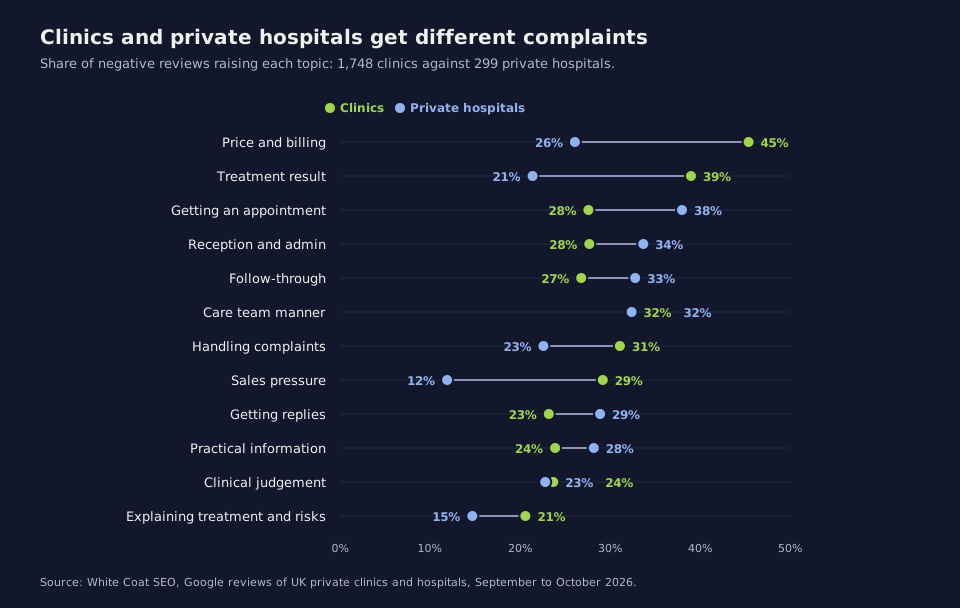
Figure 2. Lime is clinics, blue is private hospitals. The pair of figures beside each row reads clinics then hospitals.
Sales pressure comes up in 29% of clinic reviews and 12% of hospital reviews. Getting an appointment is 28% at clinics and 38% at hospitals. If you run a clinic, your patients are not complaining about the same things as the patients at the private hospital down the road, so do not read the hospital figures as yours.
"cancelling the appointment the day before due to staffing issues"
"They cancelled my appointment last minute"
"it has been almost three weeks and they didn't call back"
"erroneously sent me another client's treatment plan"
One thing to know when reading the hospital figures: 7% of negative hospital reviews say the visit was NHS-funded, against 2% at clinics. Private hospitals treat NHS patients under contract, so those reviews stay in the hospital figures.
Listings in a named doctor's or surgeon's own name are a third group, reported on their own: 816 practitioners with 1,803 negative reviews. Their complaints lean towards the person. Patients raise the care team's manner in 46% of their negative reviews, the treatment result in 45%, price in 40%, and clinical judgement, meaning whether the patient felt properly examined and taken seriously, in 39%. That last figure is 24% at clinics.
Your specialty predicts your complaints
This is the finding I did not expect to be so clear. We compared each specialty with all UK clinics and marked every topic where the gap was larger than the margin of error for that specialty's sample, once counting every review and once counting every clinic, so that one clinic with hundreds of reviews cannot carry a gap on its own. Thirteen of the fifteen specialties with full results have at least one such topic, with a median of three.
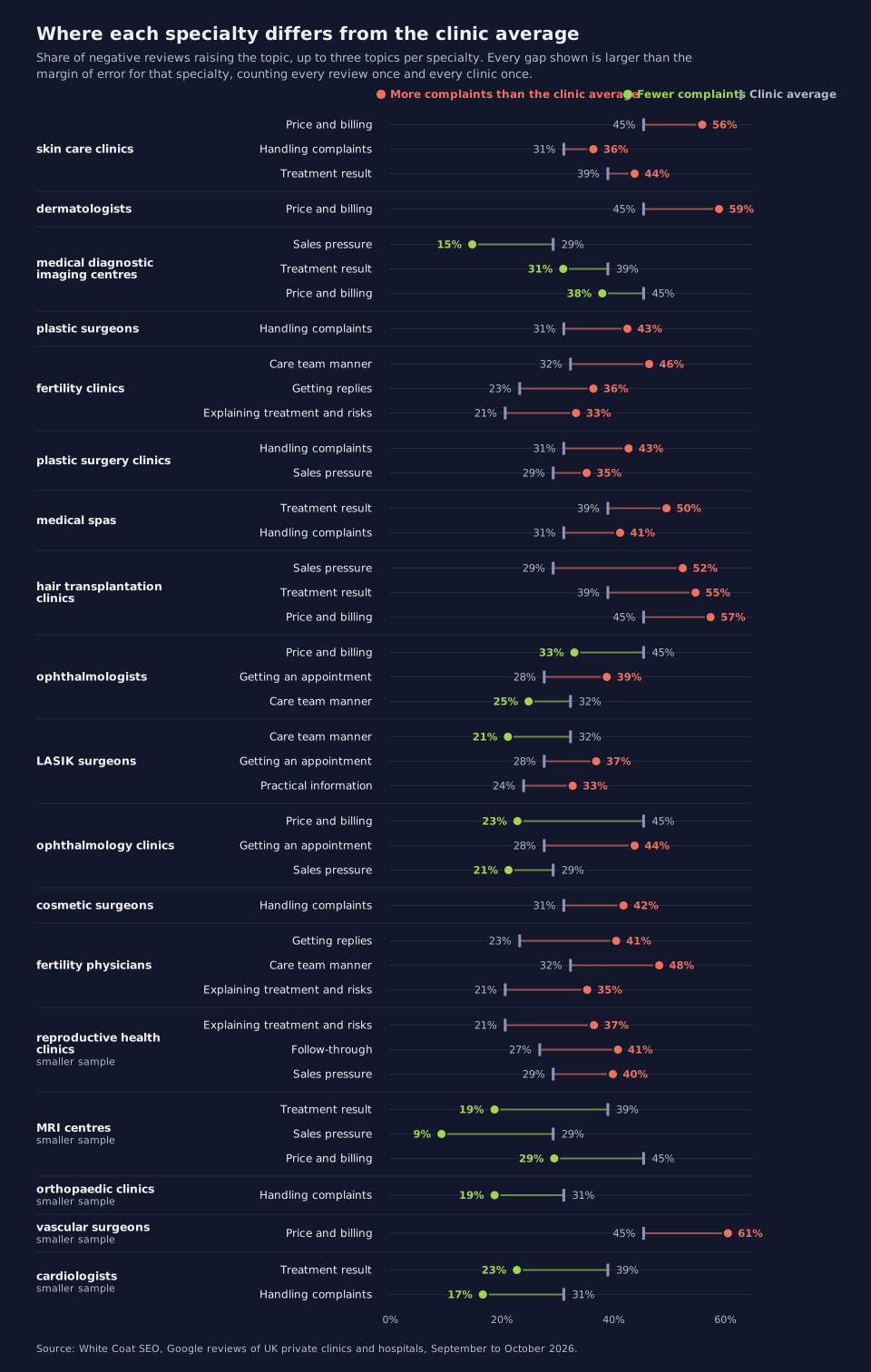
Figure 3. Every specialty with a gap beyond its margin of error, up to three topics each, full samples first. The dot is the specialty: red where it has more complaints than all UK clinics, lime where it has fewer. The bar is all UK clinics.
Some of these gaps are the service itself: an MRI centre has no treatment to go wrong. Others are the clinic's to fix, and those are the ones to read: hair transplant patients report being sold to, fertility patients complain about the care team's manner, and eye patients cannot get an appointment.
The reviews of clinics patients cannot reach read like this:
"rings out to answering machine."
"they are now refusing to reply to my emails"
"emailed and phoned a number of times"
And the reviews of clinics whose patients felt processed rather than treated:
"behaves like he works in a factory on a production line"
"feel unwanted and like a second class citizen"
"She walked off to deal with her 'preferred client'"
The table shows every specialty with a full sample. The last column is the topic where the specialty sits furthest from all clinics, provided that gap is larger than the margin of error.
| Specialty | Negative reviews | Most raised | Stands out most, against all clinics |
|---|---|---|---|
| Skin care clinics | 4,107 | Price and billing, 56% | Price and billing higher: 56% against 45% |
| Dermatologists | 2,794 | Price and billing, 59% | Price and billing higher: 59% against 45% |
| Diagnostic imaging centres | 1,492 | Price and billing, 38% | Sales pressure lower: 15% against 29% |
| Plastic surgeons | 1,303 | Price and billing, 48% | Handling complaints higher: 42% against 31% |
| Fertility clinics | 1,290 | Care team manner, 46% | Care team manner higher: 46% against 32% |
| Plastic surgery clinics | 1,101 | Price and billing, 50% | Handling complaints higher: 43% against 31% |
| Medical spas | 1,081 | Price and billing, 53% | The treatment result higher: 50% against 39% |
| Hair transplant clinics | 1,055 | Price and billing, 57% | Sales pressure higher: 52% against 29% |
| Ophthalmologists | 996 | Getting an appointment, 39% | Price and billing lower: 33% against 45% |
| LASIK surgeons | 966 | Price and billing, 38% | Care team manner lower: 21% against 32% |
| Ophthalmology clinics | 942 | Getting an appointment, 44% | Price and billing lower: 23% against 45% |
| Cosmetic surgeons | 922 | Price and billing, 50% | Handling complaints higher: 42% against 31% |
| Surgeons (general listing) | 692 | Price and billing, 47% | Nothing beyond the margin of error |
| Surgical centres | 604 | The treatment result, 40% | Nothing beyond the margin of error |
| Fertility physicians | 595 | Care team manner, 48% | Getting replies higher: 40% against 23% |
Fourteen more specialties with smaller samples, from obstetricians to cardiologists, are in the tool with the same figures.
Read the table with two things in mind. Google's categories overlap, so a business listed as both a plastic surgeon and a plastic surgery clinic counts in both rows, and the three surgery rows are largely the same businesses. And "all clinics" includes the specialty being compared, so the gap for a large specialty such as skin care clinics, a third of all clinic reviews, is understated rather than inflated.
See your own specialty
The benchmark shows what patients of your specialty complain about, against the clinic average, and where your region sits. Free, no sign-up.
Open the benchmarkYour region matters less than your specialty
I expected regions to differ too. Where we can measure it, the differences are small. Where we cannot, the gaps we see are no bigger.
The chart shows, for each region with a full sample, how far each of the eight most common topics sits from the UK figure, in percentage points. The margin of error for that region's sample is on the right.
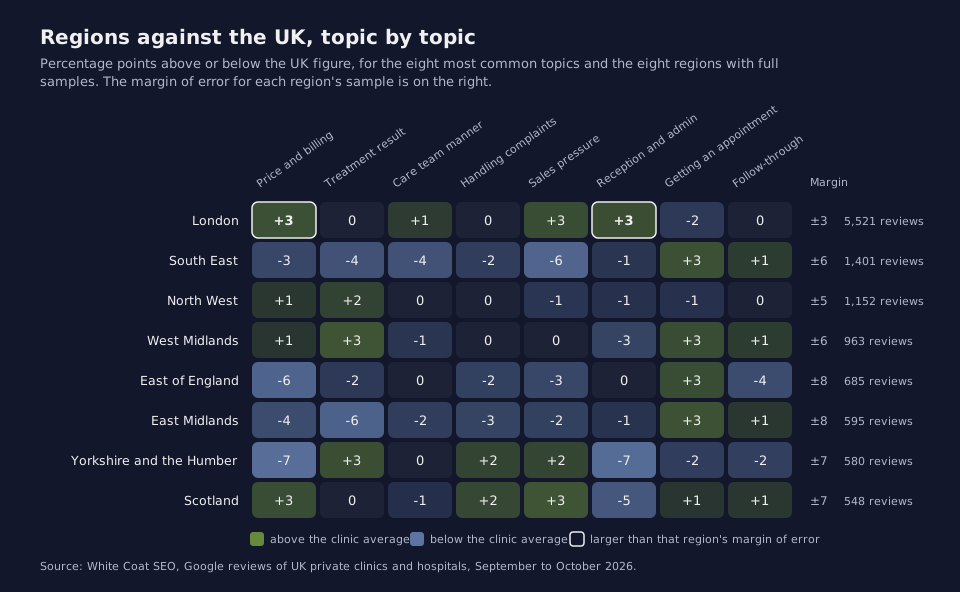
Figure 4. Each cell is the region's gap from the UK figure in points. Outlined cells are larger than that region's margin of error, shown at the right.
London is the only region with a sample tight enough to show small gaps (5,521 reviews from 604 clinics, margin 3 points), and its gaps are small: price and reception sit 3 points above the UK. The South East and the North West (1,401 and 1,152 reviews, margins 5 to 6 points) show nothing beyond their margins. The other five regions have 548 to 963 reviews and margins of 6 to 8 points, and none clears them; the largest gap, Yorkshire's price at 38% against 45%, clears the margin counting reviews but not counting clinics. So a region either differs from the UK by a few points, as London does, or by less than we can measure. The specialty gaps run to 23 points.
We checked this a second way, without regions, by comparing the 500 negative reviews nearest to each clinic with 500 drawn at random from anywhere (the method is in the methodology section). The local pools strayed about one point further from the UK figures than the random ones. Local differences exist, but for most places they are small, and a local benchmark mostly shows you the UK figures with noise added.
What five-star reviews are about
For balance, we tagged a sample of 2,699 five-star clinic reviews with the same topics, roughly one per clinic.
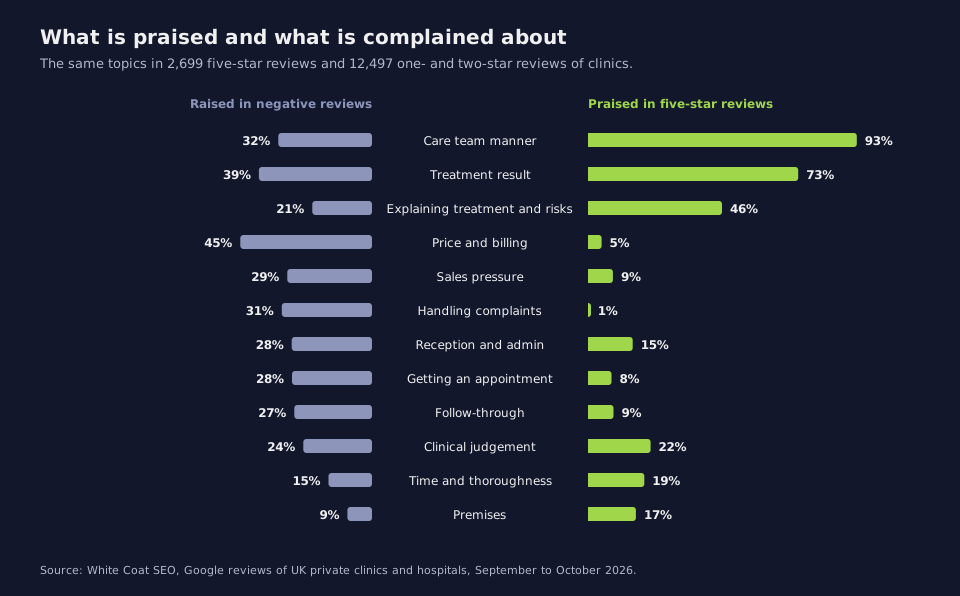
Figure 5. The same topics in five-star and negative clinic reviews.
Praise is about people and results: the care team's manner in 93% of five-star reviews, the treatment result in 73%, a clear explanation in 46%. Patients praise price in 5% of five-star reviews and complain about it in 45% of negative ones.
"I was treated with a lot of care and respect"
"the results are always natural and flawless"
"written in language the layman could understand"
"openly discussed the best approach for my skin"
Three topics appear almost only on the negative side: price, sales pressure, and what happened when something went wrong. A happy patient rarely mentions them, so a clinic only hears about them in a bad review.
The specific reasons inside each topic
Inside each topic we tagged a specific reason, from a list of about 70 built from the reviews themselves. These are the twelve most common across all clinic reviews.
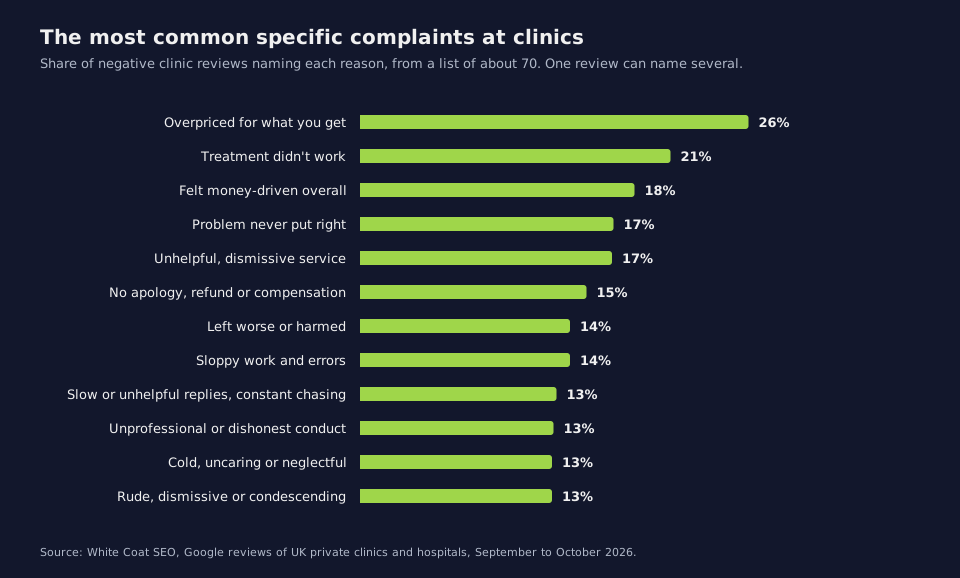
Figure 6. The twelve most common named reasons across all negative clinic reviews.
Two of the top six are about money. Two more are about what happened after the patient raised a problem: "problem never put right" and "no apology, refund or compensation".
The full list for your specialty is in the tool.
What you can do with this information
- Look up what goes wrong in your specialty. If you run a hair transplant clinic, your patients are far more likely than average to feel sold to. If you run an eye clinic, they are far more likely to struggle to get an appointment. That is the most likely source of your next bad review.
- Make the quote hold. Quote what you will charge, say what else you might charge before treatment starts, and refund without a fight when you have to. Price is the most common complaint in the reviews, and it is the one a clinic controls.
- Change what happens after a complaint. "Problem never put right" and "no apology, refund or compensation" are two of the six most common reasons named in a negative review, and both happen after the clinical work is done, so they are yours to fix: put the problem right, and apologise when you got it wrong.
- If your patients never raise your specialty's top complaint, say so. If sales pressure is in half the negative reviews of hair transplant clinics and your patients never mention it, say so on your site, in plain words: you give a written quote, nobody calls to sell you anything, and the same surgeon sees you at every visit. The benchmark gives you the figure to put beside the claim.
If the problem is how your clinic shows up on Google rather than what patients write once they arrive, that is the work we do.
Methodology
Scope
We chose the businesses our readers run: UK private specialist and procedural clinics, and private hospitals, where a patient chooses a provider, pays, and reads the reviews before doing either. We left out dental practices, which are a market of their own with their own review habits and will get a separate article. We left out GPs and NHS services, which patients do not choose on reviews in the same way, and beauty salons and allied health such as physiotherapy, which are a different kind of business with different complaints. We include named practitioners, meaning listings in a doctor's or surgeon's own name, but always report them as their own group, because a review of a person reads differently from a review of a clinic.
Finding the businesses
We started from Google's own list of healthcare business categories and chose the ones that describe private specialist care: 80 categories, from "Dermatologist" to "Fertility Clinic" to "Private Hospital". We pulled every UK listing in those categories through a data vendor: 57,984 listings, in late September 2026.
Many of those are not what we wanted: NHS departments, GP surgeries, beauty businesses, listings that are not clinics at all. We had an AI model read each listing's name, categories and website and type it as a private clinic, private hospital, named practitioner, NHS or public service, GP, beauty business, allied health, not a clinic, or unclear. For the core specialist categories we had a second model type every listing independently; the two agreed 92% of the time, and we left out the listings they disagreed on, and the ones typed as unclear. One model typed the aesthetic categories (skin care clinics, medical spas, hair transplant clinics), and we spot-checked one listing in forty; the check agreed 93% of the time. That left 12,158 clinics, hospitals and practitioners. As a check on what slipped through, the model also flagged every review whose text said the visit was NHS-funded: 2% of negative clinic reviews, and of the 666 clinics with five or more reviews, one had mostly NHS-funded ones.
Collecting the reviews
For each business we collected every one- and two-star Google review, plus up to ten five-star reviews. We asked for reviews lowest rating first, and for 90% of businesses that captured every negative review. For businesses with more than 50 negative reviews the ordering loosens and coverage falls to about 65%, and no business contributes more than about 130 negative reviews whatever its count, so the largest businesses are under-represented. In all we collected 427,000 reviews, of which 21,618 were negative reviews with text from businesses in scope. Three in four businesses in scope had no negative review with text at all.
The topics and the named reasons
We built the list of topics from the reviews themselves rather than from a list of what patients might complain about. We had an AI model, Claude, summarise about 1,200 reviews, half of them negative, from 60 clinics in five specialties, then split those summaries into two halves and built a topic list from each half on its own. The two lists agreed. We merged them into 17 topics, each defined in a sentence and each allowed to go well or badly in the same review. I then hand-coded 46 reviews against those topics myself and adjusted the definitions where I disagreed with the model. We built the named reasons the same way one level down: the model wrote a short phrase for each topic it tagged in 2,000 test reviews, and we grouped those phrases into about 70 reasons, folding the rare ones into their neighbours.
Tagging every review
The model read each of the 26,616 reviews on its own (cut at 2,000 characters, which affects a few long ones) and returned the topics it raised, whether each went well or badly, the named reasons, whether the text said the visit was NHS-funded, and whether the review was about something out of scope, such as an NHS service. We dropped the 294 reviews it flagged as out of scope and edited nothing else.
Checking the tagging
Agreement is not accuracy, and no person read all 26,616 reviews. These are the checks we ran.
- I hand-coded 46 reviews against the first version of the topic list, and the model's topic labels overlapped mine on about 70% of labels per review. The final list has no human coding.
- We had the same model tag the same 500 reviews twice. The two sets of topic labels overlapped 92%, and the named reasons 89%. That sample was mostly five-star reviews; on the 154 negative ones alone, 91% and 87%.
- We had a different model tag the same 200 reviews. Topic labels overlapped 86% and named reasons 78%. On the 75 negative ones, 81% and 75%.
- The share of reviews raising each topic moved by less than a point between the two runs over all 500, and by up to 2 points on the negative ones.
Named reasons moved more than topics between runs, so a named reason's share can sit a few points either way.
The numbers
Every percentage is the share of negative reviews that raise a topic. A review raises four topics on average, so the shares do not add to 100. Each review counts once. We also computed every figure counting each business equally, so that a clinic with 300 negative reviews weighs no more than one with three; the two methods differ by at most six points on any topic, and by two or less on most. The tool shows the second figure wherever the two differ by three points or more.
The margin of error
Any sample of reviews will differ from the UK figure by chance, and reviews of one business are not independent: a group of ten clinics with 500 reviews between them behaves more like ten observations than 500. So for each region and specialty we resampled its businesses, not its reviews. We drew the group's businesses at random with replacement, as many as the group has, 400 times, recomputed every topic's share each time, and recorded the largest change across all 17 topics. The 90th percentile of those changes is the margin we quote: about 3 points for London clinics, 5 for the North West, 7 for Scotland, and about 20 for the smallest groups in the tool. This is a bootstrap (the resampling above) with a 90% interval, not a formal hypothesis test. I'm no statistician, so the check is simple on purpose, and we keep the code with the project for anyone who wants to pull it apart.
We did this twice, counting every review once and counting every clinic once, and we call a gap a difference only when it is larger than the margin on both counts, because one or two clinics with many reviews can carry a gap on their own. That rule removed about half the gaps the review count alone had marked, including two that an earlier draft of this article reported. Because we take the margin from the largest change across all 17 topics, it already allows for testing 17 topics at once. It does not allow for testing 60 groups at once: at a 90% band about one group in ten will carry a mark by chance, more so where a group has fewer than about 20 businesses, so a single mark on a small group is a lead.
The local check
We built a pool of the 500 negative reviews nearest to each of 1,500 clinics and measured the largest gap between the pool's topic shares and the UK figures. Then we built 1,500 pools of 500 reviews drawn at random from anywhere and measured the same. The median largest gap was 6.9 points for the local pools and 5.8 for the random ones, and one local pool in seven had a topic 10 or more points off the UK figure, against one random pool in 25.
Putting my readings to the reviews
The readings in the section near the top are mine, and the data cannot confirm them. We ran two checks for consistency, after the readings were written down. First, the labels: whether two complaints appear in the same review more often in a specialty than elsewhere, and how a complaint is coded, cold rather than rude, each with a 90% interval from resampling the specialty's businesses 400 times. Second, a re-read: the same model read 1,490 negative reviews, text only, with no star rating, specialty or label, and answered four yes-or-no questions of each. Was the writer promised or sold a result and let down? Is the clinic described as busy, overbooked or running late? Is a low price or a deal mentioned? Does the writer describe their own anxiety, distress or the stakes? Each specialty's sample sat beside a sample of the same size from every other clinic, at most ten reviews per business, and where the reading is about a link, both samples were limited to reviews raising the topics in it. A review that names its own procedure gives the specialty away, and a yes is what the writer said, not what they felt. 63 of the 1,490 answers failed to parse and were dropped. A higher rate in the specialty is consistent with a reading. It is not evidence of cause.
Limitations
- It is Google reviews only, and only the negative ones with text. People who leave a one-star review are not a sample of all patients.
- The topics are what reviewers chose to write about, tagged by a model. A review that complains about price because the treatment failed carries both tags.
- Specialties are Google's categories, chosen by the business, and a business listed under three categories counts in all three.
- Practitioners, small specialties and small regions have few reviews, and the tool says so wherever that applies.
- We collected the reviews in September and October 2026. The reviews themselves date from 2010 to October 2026: half were written since January 2024, and 22% in the twelve months before we collected them.
Privacy
We name no clinic, hospital or reviewer anywhere in this article or the tool. We stripped reviewer names and profiles the moment we collected the reviews, and never stored them. The quoted fragments are at most twelve words each, copied from reviews, and checked so that none names a clinic, a reviewer or a place, and none carries an amount or a time. They are public words, so a determined reader could find a review from them, as with any Google review. The full methodology log, with every decision and every mistake along the way, stays with the project.
The benchmark tool
Pick your specialty, or your region, and see which topics come up most in the negative reviews of clinics like yours, against the clinic average: the patient complaints benchmark. It is free, it needs no sign-up, and it names no clinic.

I worked for five years as a doctor in the NHS, then left to build a medical education start-up. Growing it is where SEO clicked for me, and in 2024 I launched White Coat SEO. On this blog I publish my own research and tests, limitations and all.
More about James →